




























Views
Downloads

Grade 6 Water Cycle Terms — Printable No-Prep Worksheet

Paste this activity's link or code into your existing LMS (Google Classroom, Canvas, Teams, Schoology, Moodle, etc.).
Students can open and work on the activity right away, with no student login required.
You'll still be able to track student progress and results from your teacher account.
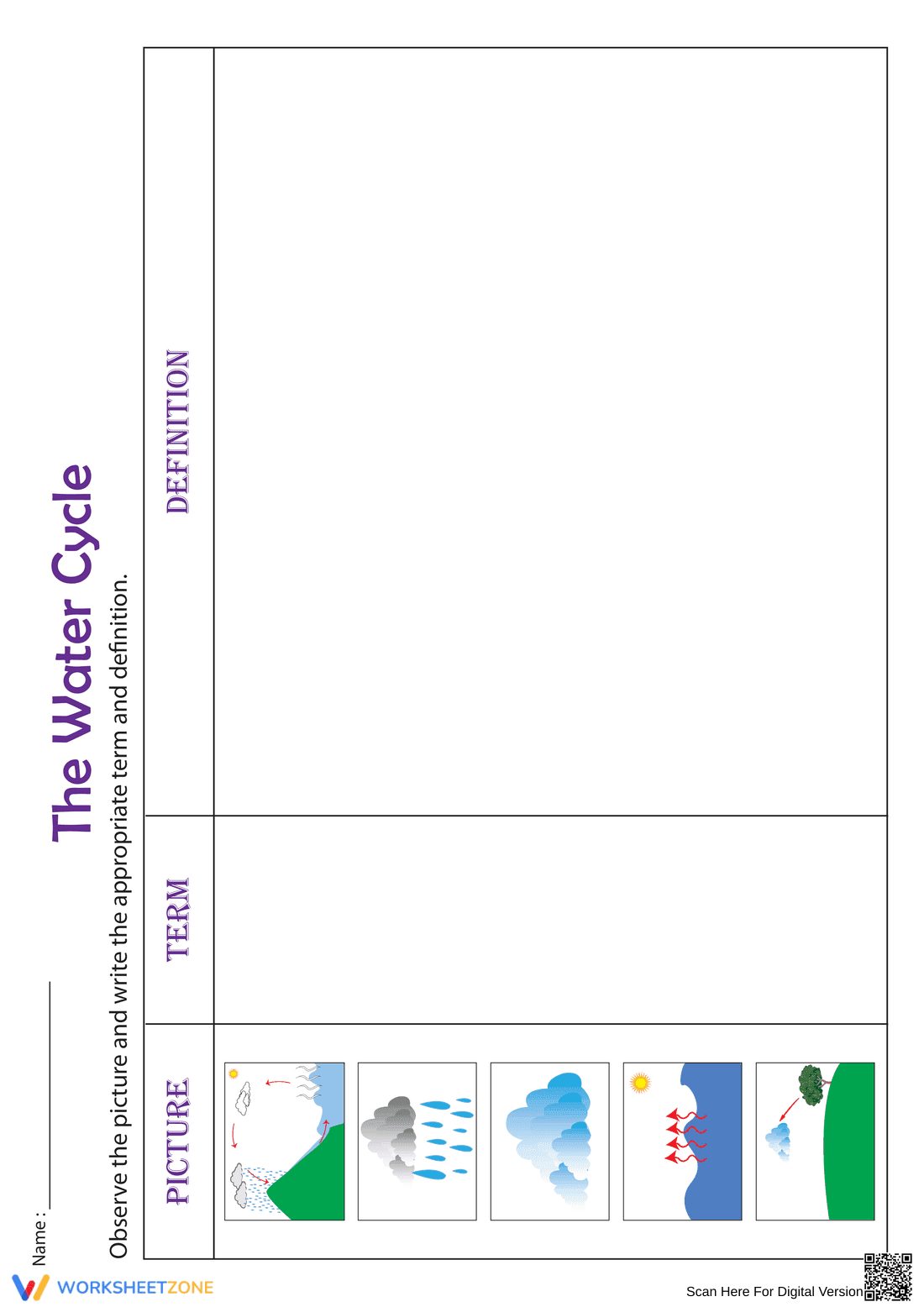
This Grade 6 science worksheet helps students master the water cycle by identifying and defining key processes. Students observe visual models of precipitation, condensation, evaporation, and transpiration, then write the correct terms and definitions. This clear, visual approach reinforces Earth science vocabulary and conceptual understanding.
At a Glance
- Grade: 6 · Subject: Science
- Standard:
MS-ESS2-4— Describe the cycling of water through Earth's systems- Skill Focus: Identifying water cycle processes
- Format: 2 pages · 5 problems · Answer key included · PDF
- Best For: Independent practice or review
- Time: 15–20 minutes
This resource includes a single-page student worksheet featuring five distinct visual models of water cycle stages. For each image, students must provide the corresponding scientific term and a brief definition. A complete, full-page answer key is provided, featuring accurate definitions for the water cycle, precipitation, condensation, evaporation, and transpiration to ensure easy grading.
- Print (1 min): Print the single-page student worksheet.
- Distribute (1 min): Hand out to students as a warm-up, review, or independent assignment.
- Review (3 mins): Use the included answer key to quickly check student responses or guide a whole-class review.
With under two minutes of total teacher prep time, this resource is perfect for busy educators or as a reliable emergency sub plan.
This worksheet aligns with MS-ESS2-4, requiring students to develop a model to describe the cycling of water through Earth's systems driven by energy from the sun and the force of gravity. By connecting visual models to specific vocabulary, students build the foundational knowledge needed to explain these complex interactions. Both standard codes can be copied directly into lesson plans, IEP goals, or district curriculum mapping tools.
Deploy this worksheet after direct instruction on the water cycle to solidify new vocabulary. It works exceptionally well as an independent practice activity or a science center station. As a formative assessment tip, observe whether students can accurately distinguish between condensation and evaporation based purely on the directional arrows in the provided images. Most students will complete the five tasks within 15 to 20 minutes.
This resource is designed for middle school science students, particularly those in 6th grade learning about Earth's systems. The strong visual cues make it highly accessible for English Language Learners and students who benefit from graphic organizers. Pair this worksheet with a hands-on water cycle demonstration or a detailed anchor chart to maximize retention.
Effectively teaching MS-ESS2-4 requires students to accurately describe the cycling of water through Earth's systems using precise scientific vocabulary. Research from ScienceDirect TpT Analysis highlights that integrating visual models with targeted vocabulary acquisition significantly improves long-term retention in middle school science classrooms. When students actively connect a visual representation to a specific term and its corresponding definition, they engage in dual-coding, which strengthens their conceptual understanding of abstract Earth science processes. This worksheet leverages that evidence-based strategy by requiring learners to interpret specific diagrams of precipitation, condensation, evaporation, and transpiration before articulating their definitions. By providing structured, image-based prompts, educators can effectively reduce cognitive load and help students focus entirely on mastering the essential terminology required for more advanced environmental science topics and complex system modeling.


